
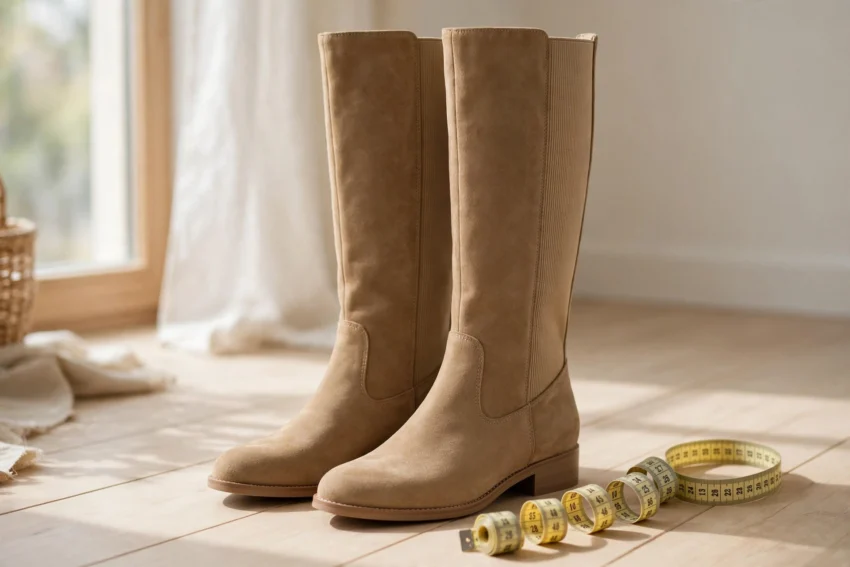
If you have wide calves, you know the problem. You find a pair of knee high boots you love, you pull the zip up, and it stops halfway. Or the boot fits, but it squeezes your calf all day and leaves a mark. Or it fits your calf, but it gapes at the top and lets the rain in. It is one of the most common fit problems in footwear, and it is also one of the easiest to solve, once you know your calf measurement and what to look for. This guide explains how to measure your calves, what wide shaft and stretch panel mean, and which boots suit wide calves best.
Direct answer
The best boots for wide calves in the UK are boots sold in a wide calf fit, with a shaft circumference that matches your calf measurement, plus a stretch back panel or an elastic gore that gives a little extra room. Measure your calf in centimetres at its widest point, then check the shaft circumference on the product page before you order. For everyday wear, a wide calf knee high boot with a stretch panel and a low block heel is often the best choice. For a smarter look, a wide calf ankle boot works well, because it does not need to fit your calf at all. Avoid boots with a narrow, rigid shaft and a short zip, because they are the hardest to fit. If you are between sizes, choose the wider shaft, and wear a thicker sock to take up the slack.
How to measure your calves
Measuring your calves takes five minutes, and it stops you guessing. Do it standing up, with your weight on both feet, and wear the leggings or jeans you will wear with the boots.
- Stand on a flat floor, with your feet hip width apart and your knees soft, not locked.
- Wrap a soft fabric tape measure around the widest part of your calf, usually about halfway between your knee and your ankle. Keep the tape level, not tilted.
- Write down the number in centimetres. Do not pull the tape tight. It should sit flat on your skin, not dig in.
- Measure the other calf too, and use the larger number when you shop.
- Measure again in the evening, when your legs are at their largest, and use that number if it is bigger.
Once you have your number, compare it with the shaft circumference listed on the product page. The shaft circumference is the measurement around the top of the boot. Many brands list it for each size, and wide calf versions are listed separately. If the brand does not list it, check the size guide, or ask the shop. Do not guess from the size alone, because the same size can have a very different shaft from one brand to the next.
| Your calf measurement | What to look for | Best boot types |
|---|---|---|
| Up to 35 cm | A standard shaft usually fits, but check the product page | Most knee high boots, ankle boots, riding boots |
| 36 to 40 cm | A wide calf fit, or a boot with a stretch back panel | Wide calf knee high boots, stretch panel boots, ankle boots |
| 41 to 45 cm | An extra wide calf fit, or a boot with a full stretch panel | Extra wide calf boots, stretch boots, slouchy boots, ankle boots |
| Over 45 cm | A boot with a very wide shaft, or an adjustable strap or buckle | Extra wide calf boots, adjustable boots, ankle boots, wellies |
The bands in the table above are typical high street bands in the UK, not an official standard. Brands use different labels, and one brand’s wide calf can be another brand’s standard fit. That is why your own measurement matters more than the label. A boot with a shaft 2 to 3 centimetres bigger than your calf will fit comfortably, with room for a thicker sock. A boot with a shaft the same size as your calf will feel tight, and the zip may not close.
Wide shaft vs stretch panel: what is the difference
Wide calf boots come in two main types, and the difference matters. A wide shaft boot is cut wider all the way round, so the whole shaft is roomier. A stretch panel boot has a panel of stretchy fabric, usually at the back, that gives a little extra room where your calf is widest. Both work, but they suit different legs.
A wide shaft boot suits calves that are wide all the way round. It looks like a normal boot, just roomier, and it holds its shape well. It is the best choice if your calf is evenly wide, and you want a smart, structured look. Check the shaft circumference on the product page, because wide shaft boots still come in different widths.
A stretch panel boot suits calves that are wide in one place, or legs that change size during the day. The panel stretches to fit your calf, then springs back. It is more forgiving than a rigid wide shaft, and it is often more comfortable if your calves swell by the evening. The panel is usually at the back, so it is hidden when you wear the boot. A full stretch boot, where the whole shaft is stretchy, gives the most room, but it can look less structured than a leather boot.
Some boots have both: a wide shaft and a stretch panel. Those give the most room, and they are the easiest to fit. An adjustable strap or buckle at the top can help too, because you can tighten it if the boot gapes, or loosen it if it feels tight.
What to look for in a wide calf boot
Width is the first thing to check, but it is not the only thing. A wide calf boot still needs the right shape, the right zip, and the right heel. Use the checks below in the shop, or when the parcel arrives.
A long, full length zip
A long zip that runs the full length of the shaft is much easier to get on and off than a short zip. It opens the boot wide, so you can slide your foot in without forcing your calf through a narrow opening. A short zip, or a boot with no zip at all, is much harder to fit, however wide the shaft is. Check the zip before you buy. If it stops halfway down the shaft, your calf has to squeeze through the rest, and that is where it sticks.
A shaped footbed and a firm heel counter
A shaped footbed supports your arch, and a firm heel counter holds your heel steady. Press the back of the boot between your thumb and fingers. It should feel firm, not floppy. A wide calf boot that is soft at the heel will let your foot slide, and that can cause blisters. Comfort matters just as much in a wide calf boot as it does in any other shoe.
A low, steady heel
A low block heel is steadier than a stiletto, and it spreads your weight better. It also makes the boot easier to walk in, which matters if you wear it all day. A heel of about 3 to 5 centimetres is a good height for everyday wear. A flat boot is fine too, but a small heel can help the boot sit better on your leg. Avoid very high heels in a wide calf boot, because they throw your weight forward and make the shaft pull tight.
A toe shape that suits you
A rounded or square toe is kinder than a pointed one, and it gives your toes room to spread. If you have wide feet as well as wide calves, a rounded toe in a wide fit is the best choice. Our guide on how boots should fit explains how to check the fit, including calf fit.
Best boots by use
Different days need different boots. A boot for work is not the same as a boot for a wet weekend walk. Pick the type that matches how you will actually wear them, then find it in a wide calf fit.
Knee high boots
For everyday wear, a wide calf knee high boot with a stretch panel and a low block heel is often the best choice. It looks smart with jeans, a midi skirt, or a dress, and it keeps your legs warm. Look for a full length zip, so you can get it on easily, and a shaft circumference at least 2 centimetres bigger than your calf.
Ankle boots
For a smarter look, or for days when you do not want to worry about calf fit at all, a wide calf ankle boot is the easiest choice. It sits below your calf, so the shaft does not need to fit it. That makes it the simplest option, and it suits most outfits. Choose a pair with a low block heel and a rounded toe, and it will work with jeans, trousers, and dresses. Ankle boots are also easier to find in a wide fit than knee high boots, because the fit is less critical.
Riding boots
For a classic look, a wide calf riding boot is a good choice. It has a tall, straight shaft, a low heel, and a simple, clean shape. It suits jeans and a long coat, and it looks smart without trying hard. Look for a wide calf version with a stretch panel at the back, because a rigid riding boot can be very hard to fit.
Heeled boots for evenings
For evenings, a wide calf heeled boot with a block heel is the easiest choice. It looks smart with a dress or tailored trousers, and it is steadier than a stiletto. Look for a heel of about 5 centimetres or less, a rounded toe, and a stretch panel at the back. Avoid very high heels and pointed toes, even for one evening, because they put all the strain on the front of your foot.
Waterproof boots for wet weather
For wet weather, a wide calf waterproof boot or a wellington boot is the best choice. Wellies come in wide calf versions, and they are easy to find on the high street. Look for a pair with an adjustable strap or buckle at the top, so you can tighten it if the boot gapes. A waterproof walking boot with a wide fit can work too, if you need something smarter than a welly.
How to style wide calf boots
Wide calf boots are easy to style, once you know a few simple rules. The aim is to let the boot do the work, and keep the rest of the outfit simple.
With jeans, tuck skinny jeans into the boot, and let straight leg jeans sit over the top of an ankle boot. Wide leg jeans work best with an ankle boot, because the jean covers the boot and the shape stays clean. With a dress or a skirt, a knee high boot looks best with a midi length, so a little leg shows between the hem and the top of the boot. A mini skirt with knee high boots can look good too, but it is a bolder look. With tailored trousers, an ankle boot is the easiest choice, because it sits neatly under the hem.
For short legs, a knee high boot with a low heel can make your legs look longer, if the boot is the right length. Our guide on how to style knee high boots for short legs explains how to choose the shaft height and heel.
What to avoid
A few common mistakes make wide calves harder to fit. Avoid these, and you will save yourself time and wasted money.
- Buying a larger foot size to get a wider shaft. It gives you length you do not need, and the boot will slip at the heel.
- Buying a boot with a short zip and a rigid shaft. It is the hardest type to get on, however wide it is.
- Trusting the label alone. One brand’s wide calf can be another brand’s standard fit, so always check the shaft circumference.
- Forcing the zip closed. If it will not close easily, the boot is too small, and forcing it can break the zip.
- Ignoring the returns policy when you buy online. If you cannot return them, do not risk it.
Budget: what to spend
You do not need to spend a lot to get a good wide calf boot. The bands below are typical high street bands in the UK, not prices for a specific pair.
Under £60, look for a plain, well made pair from a high street range, with a stretch panel and a full length zip. At this price, focus on fit and comfort, not on brand names. Check the stitching, the zip, and the sole. A neat finish is a good sign.
Between £60 and £120, you can usually buy a wide calf boot from a comfort or high street brand, with a shaped footbed, a cushioned heel, and a good quality zip. This is the band where most people find the best value. A pair in this band that lasts two winters costs less per wear than a cheaper pair that lasts one.
Over £120, you are paying for better materials, better leather, and often a wider choice of wide calf fits. This band suits people who wear boots every day in winter. It does not guarantee comfort. A £150 boot with the wrong shaft size is still the wrong boot. Try it on, walk in it, and judge it by how it feels, not by the price tag.
Frequently asked questions
What are the best boots for wide calves in the UK?
Boots sold in a wide calf fit, with a shaft circumference at least 2 centimetres bigger than your calf, plus a stretch back panel or an elastic gore that gives a little extra room. A wide calf knee high boot with a stretch panel and a low block heel suits most women for everyday wear, and a wide calf ankle boot is the easiest choice if you do not want to worry about calf fit at all.
How do I measure my calves for boots?
Stand up, with your weight on both feet, and wrap a soft fabric tape measure around the widest part of your calf, usually about halfway between your knee and your ankle. Write down the number in centimetres, measure the other calf too, and use the larger number. Measure again in the evening, when your legs are at their largest, and use that number if it is bigger.
What does wide calf mean in boots?
Wide calf means the shaft of the boot, the part that goes around your calf, is cut wider than the brand’s standard fit. The label varies by brand, and there is no single standard across brands, so always check the shaft circumference on the product page, and compare it with your own calf measurement.
Are stretch panel boots better than wide shaft boots?
They suit different legs. A wide shaft boot suits calves that are wide all the way round, and it holds its shape well. A stretch panel boot suits calves that are wide in one place, or legs that change size during the day, because the panel gives a little extra room. Some boots have both, and those give the most room.
Can I wear knee high boots if I have wide calves and short legs?
Yes. Choose a boot with a shaft height that suits your leg, a low heel, and a wide calf fit with a stretch panel. A knee high boot with a low heel can make short legs look longer, if the boot is the right length. Try them on with the jeans or skirt you will wear them with, and check the fit in a mirror.
Do wide calf boots look different?
Not much. A wide calf boot looks like the standard version of the same style, just a little roomier around the calf. The difference is in the fit, not in the look. A stretch panel at the back is usually hidden when you wear the boot. Plain, dark wide calf boots look smart enough for work and everyday wear.
What if one calf is bigger than the other?
Fit the bigger calf, and adjust the other one with a thicker sock or an adjustable strap. Most people have one leg slightly larger than the other. If the difference is small, a thicker sock on the smaller leg will take up the slack. If the difference is large, look for a boot with a stretch panel, because it will mould to each leg.
Where can I buy wide calf boots in the UK?
Most high street shoe shops and department stores sell wide calf boots, and many sell them online too. Look for the wide calf or extra wide calf filter on the product page, and check the shaft circumference before you order. Buy from a shop with free returns, so you can send them back if they do not fit.
Conclusion
The best boots for wide calves in the UK are not the most expensive boots, and they are not the boots with the biggest name on the side. They are the boots that fit your calf, let you get the zip up easily, hold your heel steady, and still feel comfortable at the end of the day. Measure your calves in centimetres, match the shaft to the brand’s own size guide, and choose a stretch panel if your calves change size during the day. Try them on late in the day, walk in them, and send them back if they pinch. Do that, and your boots will fit properly, all winter long.
Next in the comfort footwear cluster: best sandals for bunions UK.