
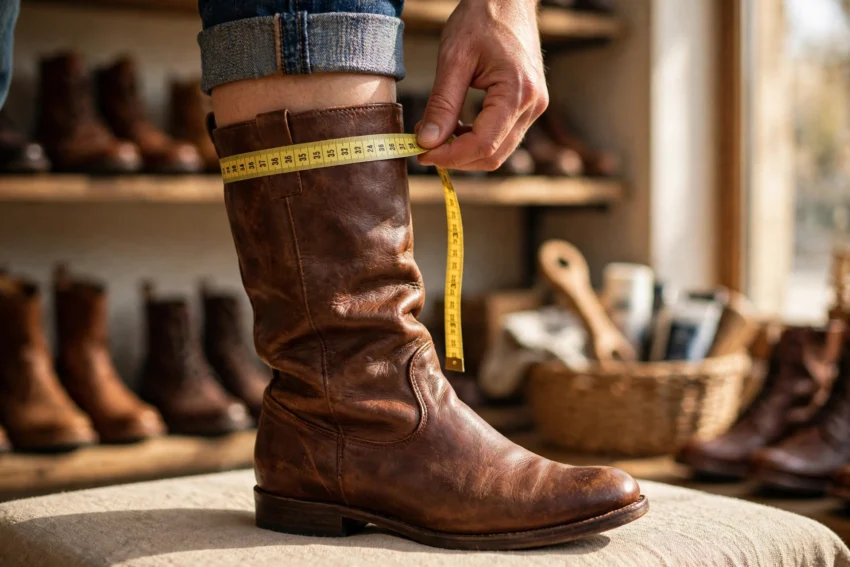
Boots that look right can still feel wrong after an hour. The heel slips, the calf pinches, or the toes go numb on a cold walk. Most fit problems come from three simple mistakes: buying your usual shoe size without checking, guessing your calf size, and trying boots on with the wrong socks. This guide fixes all three, with UK sizes and a checklist you can use in a shop or at home.
Short answer: boots should feel snug around the foot without pressing the toes, hold the heel with only a small amount of lift, and close around the calf without a gap or a pinch. Your boot size is often the same as your shoe size, but not always, so measure both feet and both calves, and try boots on with the socks you will actually wear.
How Boots Should Fit: Foot, Heel and Ankle
Start with the foot. Your toes need room to move slightly, but they should not slide forward when you walk downhill. Press down at the front of the boot. You should feel roughly a thumb width between your longest toe and the end of the boot when you stand. Less than that means the boot is too short. Far more means it is too long, and your foot will slide and blister.
The heel should sit firmly in the heel cup, with only a small lift as you walk. A little heel movement is normal in a new stiff boot, especially a tall boot, but the heel should not slip up and down freely. If it does, the boot is too wide, too long, or the wrong shape for your foot. Insoles and heel grips can help a slightly loose fit, but they cannot fix a boot that is a full size too big.
The ankle and instep matter as much as the toes. A boot should close comfortably across the instep without pressing on the top of the foot. Lace up boots let you adjust this area, which is why they suit high arches and wide feet. Chelsea boots and slip on boots have less adjustment, so the elastic or the opening must match your foot shape from the start. If a slip on boot pinches across the instep in the shop, it is unlikely to stretch enough to fix the problem.
Boot Size vs Shoe Size: Are They the Same?
For most people, boot size and shoe size are the same in the UK system. A UK size 6 shoe wearer usually takes a UK size 6 boot. There are exceptions, and they cause most online returns.
First, brands vary. One brand’s size 6 can feel like another brand’s size 5.5 or 6.5, especially across countries. UK, EU and US sizes do not convert perfectly, because brands use different lasts, which are the foot shaped forms boots are built on. Always check the brand’s own size chart, and read reviews for that exact boot, not just the brand in general.
Second, boot style changes fit. A pointed toe boot feels tighter than a round toe boot in the same size, because the toe box narrows sooner. A steel toe or safety boot needs more room, because the toe cap takes up space. A winter lined boot feels tighter than an unlined boot in the same size, because the lining fills the boot. If you buy a lined winter boot, try it with thick socks, and consider half a size up if your toes feel pressed.
Third, feet change during the day. Feet swell slightly by evening, and they swell more in warm weather and after walking. Try boots on in the afternoon or evening, when your feet are at their largest, rather than first thing in the morning. If you buy online, try both boots on carpet at home, walk around the house, and keep the box until you are sure.
| UK size | EU size (approx) | US women’s (approx) | US men’s (approx) |
|---|---|---|---|
| 4 | 37 | 6 | 5 |
| 5 | 38 | 7 | 6 |
| 6 | 39 | 8 | 7 |
| 7 | 40 to 41 | 9 | 8 |
| 8 | 42 | 10 | 9 |
Use this table only as a starting point. Brand charts differ, and the table cannot capture width or calf fit. When a brand chart and this table disagree, trust the brand chart for that boot.
How to Measure Your Calf for Boots
Calf measurement decides whether a tall boot fits at all. Many returns happen because the foot fits but the calf does not. Measure both calves, because they often differ, and use the larger measurement when you choose.
Stand with your feet flat and your weight even. Wrap a soft tape measure around the widest part of your calf, usually just below the knee for knee high boots. Keep the tape level and snug but not tight. Write down the number in centimetres. Then measure the shaft height you need, from the floor to just below the knee, if you are comparing knee high boots.
Compare your calf measurement with the boot’s calf circumference, which most good retailers list in the product details. Allow about 1 to 2 centimetres of ease for comfort, more if you plan to tuck jeans or thick leggings inside. If the boot has a stretch panel or an adjustable buckle, it will fit a wider range of calves. If it has no stretch and no adjustment, the stated circumference must match your calf closely, or the zip will strain and the boot will pinch.
For wide calves, look for boots labelled wide calf, extra wide calf, or with a stretch back panel. Avoid boots with a narrow, rigid shaft and a short zip, because they are the hardest to fit. For slim calves, look for a narrower shaft or an adjustable strap, because a boot that gapes at the top lets in rain and looks untidy. A boot that stands up on its own when empty often has a stiffer shaft, which suits slim calves better than a soft, slouchy shaft.
Wide Feet, Narrow Feet and High Arches
Wide feet need a wide fit boot, not just a larger size. Going up a size to gain width makes the boot too long, which causes heel slip and toe blisters. Look for boots sold in wide fit, or styles with a round or square toe and a lace or buckle adjustment. Leather boots stretch slightly across the width with wear, but they do not stretch in length, so width problems rarely fix themselves fully.
Narrow feet suit lace up boots, boots with buckles, and styles with a snug ankle. Avoid wide, unstructured boots that rely on bulk to stay up. Insoles can take up volume in a slightly loose boot, and thick socks help for winter boots, but a boot that is far too wide will always feel loose.
High arches need support under the arch and room over the instep. A removable insole helps, because you can replace it with a supportive insole that matches your arch. Flat feet need the same insole trick in reverse: a supportive insole stops the foot rolling inward and wearing the boot unevenly. If you have persistent foot pain, numbness or a medical foot condition, see a podiatrist rather than relying on a boot guide. This guide covers normal fit, not medical advice.
Socks and Fit: The Detail Most People Miss
Socks change fit more than most buyers expect. A thick walking sock can take up half a size of room. A thin dress sock leaves a boot feeling loose. Try boots on with the socks you will wear with them, not with the thin pop socks offered in a shop.
For winter boots, use a medium weight merino or wool blend sock. For work boots, use the work sock you wear daily. For dress boots, use the tights or socks you will pair them with. If you wear boots with both thin and thick socks, fit them with the thicker sock, because a slightly loose boot with thin socks is easier to manage than a tight boot with thick socks.
Break in matters too. Leather boots soften and mould slightly to your foot over the first few wears. Wear new boots around the house for short periods before a long walk. If a boot pinches sharply in the shop, do not assume it will break in. Mild stiffness softens. Sharp pressure points usually stay.
Boot Fitting Checklist
Use this checklist every time you buy boots, in a shop or from an online order.
- Measure both feet and both calves, and use the larger number for each.
- Try boots on in the afternoon, with the socks you will wear.
- Check toe room: about a thumb width when standing.
- Check heel hold: small lift only, no free slipping.
- Check instep: closes without pressing on the top of the foot.
- Check calf: closes without a gap or a pinch, zip runs smoothly.
- Walk, stand and bend: no sharp pressure, no numb toes.
- Try both boots, not just one, because feet differ.
- Keep the box and receipt until you have worn them outside once.
For care once the fit is right, see our guides to how to waterproof leather boots, how to remove salt stains from boots, and how to store boots so they keep their shape.
Frequently Asked Questions About Boot Fit
Should boots be tight at first?
Snug is right. Tight is not. Leather boots feel firm at first and soften slightly, but they should not hurt, pinch sharply, or make your toes numb. If they do, the size or shape is wrong.
Do I need a different size for boots than for shoes?
Usually no, in the same brand and system. Allow for style differences: lined boots, pointed toes and safety toes can all feel tighter. When in doubt, check the brand chart and read fit reviews for that exact boot.
How do I measure my calf for knee high boots?
Stand flat, wrap a soft tape around the widest part of your calf, and note the centimetres. Compare it with the boot’s calf circumference, allowing 1 to 2 centimetres of ease. Measure both calves and use the larger one.
What if one foot is bigger than the other?
Fit the larger foot. Most people have one foot slightly larger. A boot that fits the larger foot can be adjusted for the smaller one with an insole or a thicker sock. A boot that fits only the smaller foot will hurt the larger one.
Can wide calf boots be altered?
A cobbler can sometimes add a stretch panel or move a zip, but alteration costs vary and it does not suit every boot. It is usually better to buy a boot made for your calf size than to plan an alteration.
Conclusion
Good boot fit is not mysterious. It is a thumb width at the toes, a held heel, a comfortable instep, and a calf measurement taken before you buy. Measure first, try on with the right socks, and use the checklist before you commit. Boots that fit properly last longer, feel better, and stay comfortable through a full UK winter.