
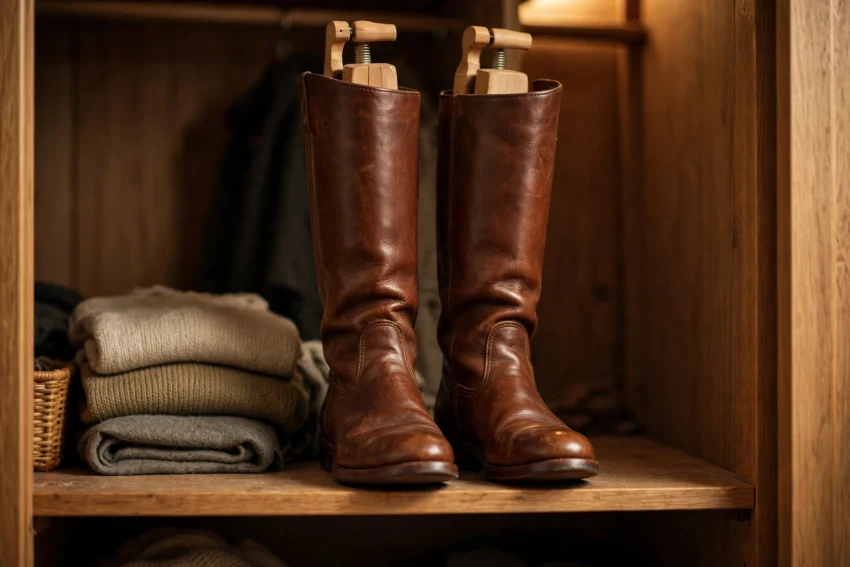
Boots lose their shape quietly. One winter in a crowded cupboard, and tall boots slump, ankle boots crease, and suede goes flat. Good storage prevents most of that damage, and it costs far less than replacing a pair. This guide covers how to store boots so they keep their shape, whether you wear them daily in winter or put them away for summer.
Short answer: clean and dry boots first, support the shaft so it stands upright, keep the toe shape with stuffing or a shoe tree, and store them in a cool, dry place out of direct heat and sunlight. Tall boots need shaft support. Ankle boots need toe support and space so they are not crushed.
Clean and Dry Boots Before You Store Them
Never store dirty or damp boots. Mud, road salt and moisture cause stains, stiffness and mould while boots sit unused. Brush off loose dirt, wipe leather with a damp cloth, and treat salt marks before storage. Our guide to how to remove salt stains from boots covers the leather and suede methods, including the vinegar safety steps for suede.
Let boots dry naturally at room temperature, away from radiators and direct heat. Stuff them loosely with newspaper or clean cloth while they dry, so the shape holds as the leather firms up. Do not use a hairdryer or place boots on a radiator. Fast, uneven heat cracks leather and stiffens suede. Once dry, condition smooth leather lightly if it feels dry, and brush suede to lift the nap before storage.
Boot Trees, Stuffing and Shaft Support
Boot trees are the best support for tall boots. A good boot tree fills the shaft, keeps it upright, and prevents the ankle crease from deepening. Wooden trees also absorb a little moisture, which helps in damp UK homes. If you do not own boot trees, use rolled magazines, pool noodles cut to shaft height, or sturdy cardboard inserts wrapped in cloth. The goal is the same: the shaft must stand straight, not fold at the ankle.
For ankle boots, a shoe tree or simple toe stuffing is enough. Stuff the toe firmly but not so tightly that it stretches the leather. Tissue paper, clean socks or purpose made shoe shapers all work. Avoid newspaper printed with heavy ink directly against light coloured suede, because ink can transfer. Wrap the stuffing in a clean cloth for pale boots.
Do not hang boots by their pull tabs for long term storage. Hanging stretches the tabs and distorts the shaft. Stand boots upright, side by side, with space between pairs. If space is tight, store one pair per box rather than stacking pairs on top of each other.
How to Store Tall Boots, Ankle Boots and Knee High Boots
Tall and knee high boots need the most care. Use boot trees or shaft inserts, stand them upright, and keep them where they will not be knocked over. If you use boot clips, clip them at the top of the shaft and hang the pair only for short periods, such as drying after a wet day. For months of storage, upright with inserts is better.
Ankle boots store well in their original box with tissue in the toe, or on a shelf with a shoe tree inside. Keep the pair together and do not wedge them between heavier shoes. Chelsea boots, which have elastic sides, need particular care. Do not fold the elastic or crush the ankle, because stretched elastic does not recover well.
For boots you wear daily in winter, a boot tray by the door works as short term storage, but it is not long term storage. Wet boots on a tray need airflow and a chance to dry between wears. Rotate pairs when you can, so no single pair stays damp day after day.
Boxes, Bags and Storage Spaces in UK Homes
Original boxes are good for storage, because they are sized for the pair and they stack neatly. Add a silica gel sachet or a small bag of dry rice in a cloth pouch to absorb moisture, and replace it each season. Avoid sealed plastic bags and airtight boxes for leather boots, because trapped moisture encourages mould. Cotton dust bags breathe better and still keep dust off.
Choose a cool, dry, dark place: a bedroom wardrobe shelf, a hallway cupboard away from the boiler, or an under bed box with airflow. Avoid lofts that freeze and overheat, damp garages, and spaces next to radiators. Sunlight fades leather and suede, and heat dries leather until it cracks. If you must use a loft or garage, use a sturdy box, add moisture absorbers, and check the boots monthly.
Label boxes by pair and season. That small step prevents the common problem of opening five boxes to find one pair, and it stops you stacking heavy boxes on delicate boots. Keep boots you wear often within easy reach, and seasonal boots higher up or further back.
Storage Mistakes That Ruin Boot Shape
The most common mistake is folding tall boots down at the ankle. That fold becomes a permanent crease and a weak point where the leather cracks. The second mistake is storing boots wet or salty. Salt continues to damage leather and suede in storage, and dampness leads to mould and smell.
Other mistakes include stacking heavy shoes on soft boots, stuffing boots so tightly that they stretch, and using wire hangers or clips that dent the shaft. Do not store boots in a pile at the bottom of a wardrobe. Pressure from above flattens toes and crushes shafts over time. Give each pair its own space, even if that space is small.
Seasonal Storage: Putting Boots Away for Summer
For summer storage, clean boots thoroughly, condition smooth leather, and proof them if they will face rain again next winter. Our guide to how to waterproof leather boots for UK weather explains proofing by leather type, which is best done before storage so the protection is ready for autumn.
Insert boot trees or shaft supports, stuff the toes, and place boots in cotton bags or boxes with moisture absorbers. Store them upright in a cool, dry place. Check them once mid summer, especially in humid homes, and rebrush suede if the nap has flattened. A five minute check prevents a September surprise.
Frequently Asked Questions
Do I need boot trees for ankle boots?
Not always. Ankle boots usually need toe stuffing or a shoe tree, not a full boot tree. Tall and knee high boots benefit most from boot trees, because the shaft is the part that slumps.
Can I store boots in their original box?
Yes, original boxes are ideal if they are clean and dry. Add tissue in the toe, keep the box in a cool, dry place, and avoid stacking heavy boxes on top.
How do I stop tall boots from flopping over?
Use boot trees, rolled magazines or pool noodles inside the shaft so the boot stands upright. Do not fold the shaft down, because that creates a permanent crease.
Should boots be stored in plastic bags?
No, for leather and suede. Sealed plastic traps moisture and encourages mould. Cotton dust bags breathe better and still protect against dust.
How often should I check stored boots?
Check seasonal boots once mid season, and daily wear boots each time you clean them. Look for dampness, mould, salt marks and flattened shafts, and fix problems early.
Conclusion
Storing boots well comes down to three habits: clean and dry them first, support the shaft and toe, and keep them in a cool, dry place with room to breathe. Boot trees help tall boots most, toe stuffing helps ankle boots, and avoiding damp, heat and crushing prevents most long term damage. With those habits, your boots will hold their shape from one winter to the next.