
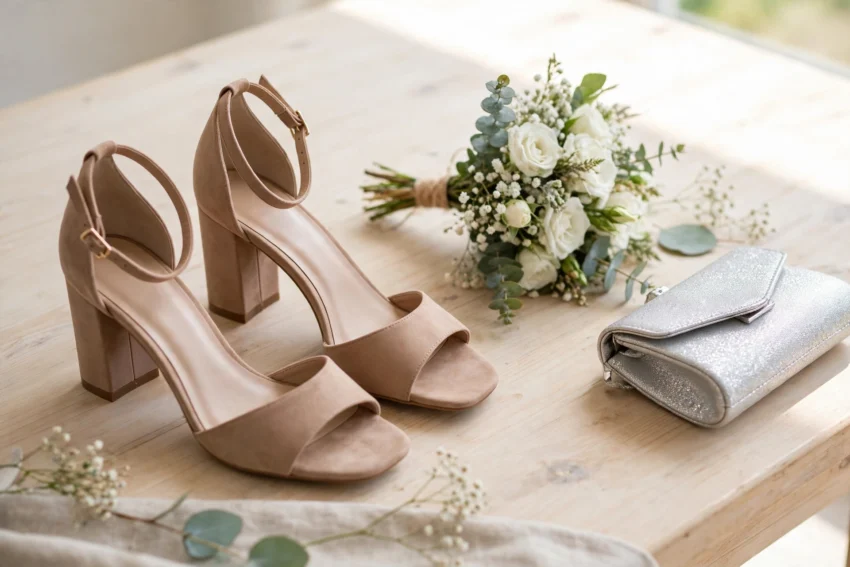
As a wedding guest, your shoes have a harder job than the bride’s. The bride wears hers for the photos. You wear yours for the ceremony, the drinks, the meal, the speeches, and the dancing, often on grass, gravel, or a dance floor, from midday until midnight. A heel that looks perfect in the shop can hurt by the first dance, or sink into the lawn before the photos are done. The best heels for a wedding guest in the UK are the ones that suit the venue, the dress code, and your feet, and that you can still walk in at the end of the night. This guide explains heel height by venue, the best heel types for guests, comfort picks, and what not to wear.
Direct answer
The best heels for a wedding guest in the UK are block heels or wedges of about 5 to 7 centimetres, with a cushioned footbed and an ankle strap, in a colour that suits your outfit and the dress code. A block heel is steadier than a stiletto, it does not sink into grass, and it is easier to walk in for a full day. For a church wedding, a mid heel of about 5 centimetres is often the best choice. For a garden wedding, a wedge or a block heel works best, because a stiletto sinks into the lawn. For a beach wedding, a wedge or a flat sandal is the safest choice. If you have wide feet or bunions, choose a wide fit heel with a rounded toe and soft uppers. Take a pair of comfortable flats for the dancing, and break your heels in at home before the day.
Heel height by venue
The venue decides the heel more than the outfit does. A heel that works in a hotel ballroom will not work on a lawn, and a heel that works on a beach will look wrong in a church. Use the table below as a starting point, then check the venue before you buy.
| Venue | Best heel height | Best heel types | What to avoid |
|---|---|---|---|
| Church | About 5 cm | Block heel, kitten heel, mid heel | Very high stilettos, noisy heels on stone floors |
| Garden or marquee | About 5 to 7 cm | Wedge, block heel | Stilettos, which sink into grass |
| Beach | Flat or low wedge | Wedge, flat sandal | Any thin heel, which sinks into sand |
| Registry office | About 5 cm | Block heel, kitten heel, court shoe | Very high heels, very casual flats |
| Hotel ballroom | About 5 to 8 cm | Block heel, stiletto, kitten heel | Heels with no ankle strap, if you plan to dance |
The heights in the table above are typical UK high street bands, not an official standard. Brands use different labels, and one brand’s mid heel can be another brand’s high heel. That is why the shape of the heel matters more than the number. A 7 centimetre block heel is easier to walk in than a 5 centimetre stiletto, because the block spreads your weight. A wedge is steadier than a stiletto at the same height, because the whole sole touches the ground. Judge the heel by how it feels when you walk, not by the number on the box.
Best heel types for a wedding guest
Different heel types suit different guests, venues, and outfits. Pick the type that matches how you will actually spend the day, then find it in a colour that suits your outfit.
Block heels
For most wedding guests, a block heel is the best choice. It has a wide, square heel that spreads your weight, so it is steadier than a stiletto and easier to walk in for a full day. It does not sink into grass, it does not slip on gravel, and it looks smart with a dress or tailored trousers. Look for a block heel of about 5 to 7 centimetres, with a rounded toe and an ankle strap. A nude or metallic block heel works with most outfits, and it is the easiest colour to match.
Wedges
For a garden or beach wedding, a wedge is the best choice. The whole sole touches the ground, so it is the steadiest heel type, and it does not sink into grass or sand. A wedge of about 5 to 7 centimetres is a good height for a garden wedding. A lower wedge, or a flat sandal, is better for a beach wedding. Wedges suit summer dresses and wide leg trousers well. Avoid a very high wedge, because it can feel heavy and it makes the shoe harder to walk in.
Kitten heels
For a church wedding or a registry office, a kitten heel is the best choice. It is a short, slim heel of about 3 to 5 centimetres, and it looks smart without trying hard. It suits a midi dress, a tailored suit, or a smart jumpsuit. A kitten heel is easy to walk in, and it is a good choice if you do not wear heels often. It is less steady than a block heel on grass, so save it for a venue with a hard floor.
Stilettos
For a hotel ballroom or an evening wedding, a stiletto can work, but only if you can walk in it. A stiletto of about 7 centimetres or less, with an ankle strap and a cushioned footbed, is the easiest to wear. A stiletto with no strap will slip off your heel when you dance. A very high stiletto, over 8 centimetres, is hard to walk in for a full day, and it will hurt by the evening. If you love stilettos, wear them for the ceremony and the photos, then change into flats for the dancing.
Mid heels and court shoes
For a smart, simple look, a mid heel court shoe is the easiest choice. It is a closed toe shoe with a heel of about 5 centimetres, and it suits most wedding outfits. It looks smart with a dress, a skirt, or tailored trousers, and it is easy to walk in. A court shoe with a rounded toe is kinder than a pointed one, and it gives your toes room to spread. If you have wide feet, look for a wide fit court shoe, because a narrow one will pinch by the afternoon.
Comfort picks: all-day wear
A wedding is a long day, and comfort matters more than style by the evening. A heel that hurts by the speeches will ruin the day, however good it looks. Use the checks below when you try heels on, and do not buy a pair that hurts in the shop. It will not get better on the day.
A cushioned footbed and a firm heel counter
A cushioned footbed, with a soft layer under the ball of your foot, takes the force out of each step. Press the footbed with your thumb. It should feel soft and springy, not hard and flat. A firm heel counter holds your heel steady and stops your foot sliding forward into the front of the shoe. Press the back of the shoe between your thumb and fingers. It should feel firm, not floppy. A heel that is soft at the back will let your foot slide, and that can cause blisters.
An ankle strap
An ankle strap holds your heel in place, so your foot does not lift out of the shoe with every step. It is the most useful feature for a wedding guest, because it stops the shoe slipping when you walk on grass, gravel, or a dance floor. A strap with a buckle is better than an elastic strap, because you can adjust it. If the strap is too tight, it will cut into your ankle. If it is too loose, it will not hold your heel.
Wide fit and bunion friendly heels
If you have wide feet or bunions, a wide fit heel with a rounded toe and soft uppers is the best choice. A pointed toe squeezes your big toe towards the other toes, which hurts a bunion. A wide fit heel gives your toes room to spread, and soft uppers mould to the shape of your foot instead of pressing on the joint. Our guide on the best sandals for bunions UK explains what makes footwear bunion friendly, and the same ideas, a wide toe box, soft uppers, and adjustable straps, work for heels too. Try the heel on late in the day, when your feet are at their largest, and walk in it for at least ten minutes before you buy.
What to wear with your heels
Your heels should suit your outfit, the season, and the dress code. A heel that clashes with your dress will stand out for the wrong reasons.
With a midi dress, a block heel or a kitten heel looks best, because the heel is visible and it should suit the dress. With a maxi dress, a wedge or a block heel works well, because the heel is mostly hidden and comfort matters more. With tailored trousers, a court shoe or a block heel is the easiest choice, because it sits neatly under the hem. With a jumpsuit, a block heel or a wedge looks smart, and it is easier to walk in than a stiletto.
For colour, a nude heel works with most outfits, and it makes your legs look longer. A metallic heel, gold or silver, works with most dresses and it suits an evening wedding. A heel in the same colour as your dress can look smart, but it is harder to match exactly. A black heel works with most outfits, but it can look heavy with a light summer dress. Avoid white heels, unless the dress code says so, because white is the bride’s colour.
What not to wear as a guest
A few choices will make you stand out for the wrong reasons, or make the day harder than it needs to be. Avoid these, and you will enjoy the day more.
- White or ivory heels, or a white outfit. White is the bride’s colour, and wearing it as a guest is a mistake.
- Very high stilettos for a garden wedding. They sink into the grass, and you will spend the day trying not to fall over.
- Brand new heels, worn for the first time on the day. Break them in at home first, or they will blister your feet.
- Heels with no ankle strap, if you plan to dance. They will slip off your heel, and you will spend the evening holding them on.
- Very casual shoes, such as trainers or flip flops, unless the dress code says so. A wedding is a smart occasion, even if it is outdoors.
- Heels that hurt in the shop. If they pinch when you try them on, they will hurt more by the evening.
All-day comfort plan
A little planning before the day makes the day much easier. Use the plan below, and your feet will thank you by the evening.
- Break your heels in at home, for an hour at a time, with the socks or tights you will wear on the day. Walk around the house, up and down the stairs, and sit down in them too.
- Wear them for a full evening at home, a week before the wedding. If they rub, use a heel grip or moleskin, and try again the next day. If they still rub after a week, they are the wrong fit.
- Pack a pair of comfortable flats in your bag, for the dancing. A foldable flat, or a simple ballet flat, takes up little room and saves your feet.
- Take heel protectors, small caps that fit over a stiletto heel, if the wedding is on grass. They stop the heel sinking into the lawn, and they are cheap and easy to carry.
- Take blister plasters, in case a heel rubs. Stick one on at the first sign of rubbing, not when the blister has already formed.
- Check the venue before the day. Ask the couple, or check the venue website, for the surface, grass, gravel, or a hard floor, so you know which heel to wear.
If your heels rub on the day, change into your flats early, not when your feet are already sore. A wedding is a long day, and no one will notice your flats under a long dress. Our guide on how to choose comfortable wedding shoes explains how to check the fit, including width and heel height, and the same measuring ideas help with any wedding heel you buy.
Budget: what to spend
You do not need to spend a lot to get a good wedding guest heel. The bands below are typical high street bands in the UK, not prices for a specific pair.
Under £50, look for a plain, well made pair from a high street range, with a block heel, a cushioned footbed, and an ankle strap. At this price, focus on fit and comfort, not on brand names. Check the stitching, the strap, and the sole. A neat finish is a good sign. Avoid very cheap heels with cardboard feeling soles, because they wear out in weeks and cost more in the long run.
Between £50 and £100, you can usually buy a wide fit heel from a comfort or high street brand, with a shaped footbed, a cushioned heel, and good quality straps. This is the band where most people find the best value. A pair in this band that lasts for several weddings costs less per wear than a cheaper pair that lasts one.
Over £100, you are paying for better materials, better leather, and often a wider choice of wide fits. This band suits people who go to weddings often. It does not guarantee comfort. A £120 heel with the wrong fit is still the wrong heel. Try it on, walk in it, and judge it by how it feels, not by the price tag.
Frequently asked questions
What are the best heels for a wedding guest in the UK?
Block heels or wedges of about 5 to 7 centimetres, with a cushioned footbed and an ankle strap, in a colour that suits your outfit and the dress code. A block heel is steadier than a stiletto, it does not sink into grass, and it is easier to walk in for a full day. For a church wedding, a mid heel of about 5 centimetres is often the best choice. For a garden wedding, a wedge or a block heel works best.
What heel height is best for a wedding guest?
About 5 to 7 centimetres is the best height for most wedding guests. It is high enough to look smart, and low enough to walk in for a full day. A heel of about 5 centimetres is the best choice for a church or a registry office. A heel of about 7 centimetres is fine for a hotel ballroom, if you can walk in it. Avoid heels over 8 centimetres for a full day, because they will hurt by the evening.
Can wedding guests wear stilettos?
Yes, if the venue has a hard floor and you can walk in them. A stiletto of about 7 centimetres or less, with an ankle strap and a cushioned footbed, is the easiest to wear. Avoid stilettos for a garden or beach wedding, because they sink into grass and sand. If you love stilettos, wear them for the ceremony and the photos, then change into flats for the dancing.
Are block heels OK for a wedding?
Yes, block heels are one of the best choices for a wedding guest. They are steadier than stilettos, they do not sink into grass, and they are easier to walk in for a full day. A block heel of about 5 to 7 centimetres looks smart with a dress or tailored trousers, and it suits most venues, including a church, a garden, and a hotel ballroom.
What shoes should a wedding guest wear on grass?
A wedge or a block heel, because they do not sink into the lawn. A stiletto sinks into grass, and it makes walking hard. Heel protectors, small caps that fit over a stiletto heel, can help if you want to wear a stiletto, but a wedge or a block heel is the safer choice. Take a pair of comfortable flats for the dancing, and check the venue before the day.
Can I wear flats to a wedding as a guest?
Yes, if they are smart flats. A simple ballet flat, a pointed flat, or a smart loafer can look good with a dress or tailored trousers, and they are much easier to walk in than heels. Avoid very casual flats, such as trainers or flip flops, unless the dress code says so. If you wear flats, choose a pair that suits your outfit and the dress code.
What colour heels should a wedding guest wear?
A nude heel works with most outfits, and it makes your legs look longer. A metallic heel, gold or silver, works with most dresses and it suits an evening wedding. A heel in the same colour as your dress can look smart, but it is harder to match exactly. Avoid white or ivory heels, because white is the bride’s colour.
How do I stop my wedding heels hurting?
Break them in at home for a week before the wedding, wear them for an hour at a time, and use a heel grip or moleskin if they rub. Choose a heel with a cushioned footbed and an ankle strap, and take a pair of comfortable flats for the dancing. If your heels rub on the day, change into your flats early, not when your feet are already sore.
Conclusion
The best heels for a wedding guest in the UK are not the highest heels, and they are not the heels with the biggest name on the side. They are the heels that suit the venue, the dress code, and your feet, and that you can still walk in at the end of the night. A block heel or a wedge of about 5 to 7 centimetres, with a cushioned footbed and an ankle strap, will suit most weddings, most outfits, and most feet. Check the venue, break your heels in at home, and take flats for the dancing. Do that, and you will enjoy the wedding, instead of counting the hours until you can take your shoes off.
Next in the beauty cluster: how to do a french braid for beginners UK.