
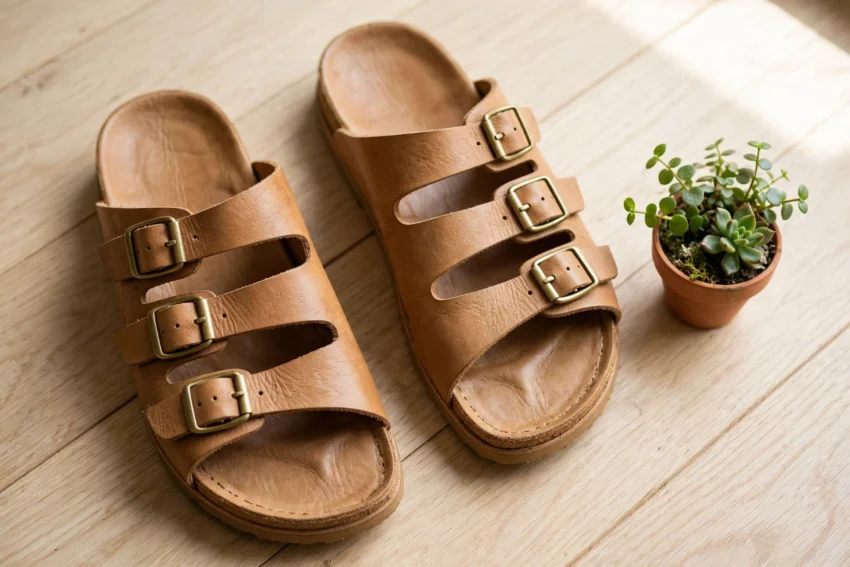
If you have a bunion, sandals can feel like a cruel joke. The one part of your foot that hurts is exactly the part most sandals squeeze. A narrow strap cuts across the joint, a pointed toe crushes your big toe, and by lunchtime you are limping. It does not have to be that way. A sandal with a wide toe box, soft uppers and adjustable straps can be comfortable all day, even with a bunion. This guide explains what a bunion is, what makes a sandal bunion friendly, and which sandals suit bunions best.
Direct answer
The best sandals for bunions in the UK have a wide toe box that gives your big toe room, soft uppers with no hard seam over the bunion, and adjustable straps so you can loosen the fit where it hurts. Look for a low heel, a cushioned footbed, and a strap you can adjust around the forefoot. For everyday wear, a wide fit leather sandal with two adjustable straps is often the best choice. For walking, a cushioned walking sandal with a deep toe box works well. Avoid narrow, pointed sandals, stiff straps that cross the bunion, and high heels. If you have pain that does not settle, swelling, or a bunion that keeps getting worse, speak to your GP or a podiatrist. This guide covers footwear only, not medical treatment.
What a bunion is, and why sandals hurt
A bunion is a bony bump that forms at the base of the big toe, where the toe meets the foot. The big toe leans towards the other toes, and the joint at the base sticks out. It can be sore, red, and tender, and it can make shoes that used to fit feel tight. Bunions are common, and they often run in families. They can also be made worse by years of wearing narrow, pointed shoes.
Sandals hurt a bunion for one simple reason: most sandals are cut narrow at the front, and the strap sits right where the bunion is. A strap that crosses the joint presses on the sore spot with every step. A pointed toe squeezes the big toe towards the other toes, which is exactly the direction the bunion already leans. A flat, hard footbed with no cushioning makes it worse, because the joint takes the full force of each step. The fix is not to stop wearing sandals. It is to wear sandals shaped for your foot.
What makes a sandal bunion friendly
Five features matter most. A sandal that has all five will usually be comfortable, even with a bunion. A sandal that has none of them will hurt, however pretty it looks.
A wide toe box
The toe box is the front of the sandal, where your toes sit. A wide toe box gives your big toe room to sit straight, instead of squeezing it towards the other toes. Look for a sandal that looks wide at the front, with a rounded or square toe, not a pointed one. If you can see your toes spreading out in the sandal, the toe box is wide enough. If your big toe is pushed against the edge, it is not. A wide fit sandal is often the best choice, because it is wider all the way through, not just at the toes.
Soft uppers with no seam over the bunion
The uppers are the straps and panels that hold the sandal on your foot. Soft leather, suede, or a stretchy fabric will mould to the shape of your foot, instead of pressing on the bunion. Check where the seams sit. A seam that runs across the bunion will rub it raw. A sandal with a smooth, unlined upper, or with the seam moved away from the joint, is much kinder. If you can, try the sandal on and press the upper over your bunion. It should feel soft, not stiff.
Adjustable straps
Adjustable straps let you loosen the sandal where it hurts and tighten it where it needs to hold. A strap with Velcro or a buckle around the forefoot is the most useful, because that is where the bunion is. A strap around the ankle helps too, because it holds your heel steady, so your foot does not slide forward into the front of the sandal. Avoid sandals with fixed, non adjustable straps, because you cannot change the fit if they press on the joint.
A low heel and a cushioned footbed
A low heel, about 2 to 3 centimetres, is steadier than a high heel, and it puts less pressure on the front of your foot. A flat sandal is fine too, but a small heel can help the sandal sit better on your foot. A cushioned footbed, with a soft layer under the ball of your foot, takes the force out of each step and protects the joint. Press the footbed with your thumb. It should feel soft and springy, not hard and flat. A shaped footbed that supports your arch helps too, because it stops your foot rolling inwards, which can make a bunion worse.
A firm heel counter
A firm heel counter holds your heel steady and stops your foot sliding forward into the front of the sandal. Press the back of the sandal between your thumb and fingers. It should feel firm, not floppy. A sandal that is soft at the heel will let your foot slide, and that pushes your big toe into the front of the sandal, which hurts the bunion. This matters just as much in a sandal as it does in a shoe.
What to avoid
Some sandals will hurt a bunion however long you wear them in. Avoid these, and you will save yourself time, money, and sore feet.
- Narrow, pointed sandals. They squeeze your big toe towards the other toes, which is exactly the direction the bunion leans.
- Stiff straps that cross the bunion. A hard leather strap over the joint presses on the sore spot with every step.
- High heels. They throw your weight forward onto the ball of your foot, and they put all the pressure on the bunion.
- Thong sandals, if the thong hurts. A thong between your big toe and second toe can be fine for some people, but if it pulls your big toe sideways, it will make a bunion worse. Try them on first, and walk in them before you buy.
- Sandals with no adjustment. If you cannot loosen the strap where it hurts, you cannot fix the fit.
- Buying a larger size to get more width. It gives you length you do not need, and your foot will slide forward into the front of the sandal.
Best sandals by style
Different days need different sandals. A sandal for a long walk is not the same as a sandal for a summer evening. Pick the type that matches how you will actually wear them, then find it in a wide fit with adjustable straps.
Everyday sandals
For everyday wear, a wide fit leather sandal with two adjustable straps is often the best choice. It looks smart enough for most days, it holds your foot steady, and you can loosen the strap over the bunion as your feet swell in the heat. Look for a rounded toe, a low heel, and a cushioned footbed. A plain, dark leather sandal works with jeans, trousers, and a summer dress. A lighter colour works well too, but it shows marks more easily.
Dressy sandals
For a smarter look, a wide fit dressy sandal with a low block heel is the easiest choice. It looks good with a dress or tailored trousers, and it is steadier than a stiletto. Look for a heel of about 3 centimetres or less, a rounded toe, and a soft upper with no seam over the bunion. Avoid very high heels and pointed toes, even for one evening, because they put all the strain on the front of your foot. If you need to be on your feet all evening, take a pair of comfortable flats to change into.
Walking sandals
For walking, a cushioned walking sandal with a deep toe box is the best choice. It has a thick, cushioned sole, a shaped footbed, and adjustable straps that hold your foot steady. It is the sandal to choose for a holiday, a long day out, or a walk in the countryside. Look for a sandal with a firm heel counter, so your foot does not slide, and a sole with grip, so you do not slip on wet pavements. If you stand all day for work, the same features help. Our guide on the best shoes for standing all day UK explains what to look for in footwear for long days on your feet, and the same ideas work for sandals too.
Beach and holiday sandals
For the beach or a holiday, a wide fit sandal with a soft, waterproof upper is the best choice. It will cope with sand and water, and it will not rub when your feet get wet. Look for a sandal with a cushioned footbed and adjustable straps, so you can loosen it as your feet swell in the heat. Avoid a thong sandal for a long day at the beach, unless you know it does not hurt your bunion, because the thong can pull your big toe sideways. A slide sandal with a wide, soft strap can be easier, but only if it does not press on the joint.
How to fit sandals for bunions
Fitting sandals for bunions takes a little more care than fitting a normal sandal, but it is worth it. Use the checks below in the shop, or when the parcel arrives.
- Shop late in the day, when your feet are at their largest. Feet swell as the day goes on, and a sandal that fits in the morning can feel tight by the evening.
- Try both feet, and fit the larger one. Most people have one foot slightly larger than the other, and one bunion can be bigger than the other.
- Loosen all the straps before you put the sandal on, then tighten them one at a time. Start with the ankle strap, then the forefoot strap, and leave a little slack over the bunion.
- Walk for at least ten minutes in the shop, on a hard floor if you can. Walk, turn, and stand still. If the strap presses on your bunion, or your big toe is pushed against the edge, it is the wrong fit.
- Check the toe room. You should be able to wiggle your toes, and your big toe should not touch the edge of the sandal.
- Press the upper over your bunion. It should feel soft, not stiff, and there should be no seam pressing on the joint.
- Buy from a shop with a good returns policy, and keep the receipt. If they rub at home, you can take them back.
If a sandal rubs in one small spot, a piece of moleskin on the inside of the strap, or a blister plaster on your skin, can help while the sandal softens. If it rubs after a week of wearing it at home, it is probably the wrong fit, not just stiff. A sandal that hurts the same on day seven as it did on day one is not going to get better.
Budget: what to spend
You do not need to spend a lot to get a good bunion friendly sandal. The bands below are typical high street bands in the UK, not prices for a specific pair.
Under £50, look for a plain, well made pair from a high street range, with a wide toe box and adjustable straps. At this price, focus on fit and comfort, not on brand names. Check the stitching, the straps, and the sole. A neat finish is a good sign. Avoid very cheap sandals with cardboard feeling soles, because they wear out in weeks and cost more in the long run.
Between £50 and £100, you can usually buy a wide fit sandal from a comfort or high street brand, with a shaped footbed, a cushioned heel, and good quality straps. This is the band where most people find the best value. A pair in this band that lasts two summers costs less per wear than a cheaper pair that lasts one.
Over £100, you are paying for better materials, better leather, and often a wider choice of wide fits. This band suits people who wear sandals every day in summer. It does not guarantee comfort. A £120 sandal with the wrong toe box is still the wrong sandal. Try it on, walk in it, and judge it by how it feels, not by the price tag.
Wide feet and bunions
Bunions and wide feet often go together. A wide foot needs a wide sandal, and a bunion needs room at the front. If you have both, a wide fit sandal is the best choice, because it is wider all the way through. Our guide on the best trainers for wide feet women explains how to measure your width and which brands offer wide fits, and the same measuring ideas help with sandals too.
When you shop for wide fit sandals, check the width as well as the length. A sandal in your usual size, but in a wide fit, will usually fit better than a sandal a size larger in a standard fit. A larger size gives you length you do not need, and your foot will slide forward into the front of the sandal, which pushes your big toe into the edge and hurts the bunion.
Frequently asked questions
What are the best sandals for bunions in the UK?
Sandals with a wide toe box that gives your big toe room, soft uppers with no hard seam over the bunion, and adjustable straps so you can loosen the fit where it hurts. A wide fit leather sandal with two adjustable straps suits most women for everyday wear, and a cushioned walking sandal with a deep toe box is the best choice for long days on your feet.
Can I wear sandals if I have bunions?
Yes, if you choose the right sandal. Look for a wide toe box, soft uppers, and adjustable straps. Avoid narrow, pointed sandals, stiff straps that cross the bunion, and high heels. If you have pain that does not settle, swelling, or a bunion that keeps getting worse, speak to your GP or a podiatrist.
Are wide fit sandals better for bunions?
Yes, usually. A wide fit sandal is wider all the way through, so your big toe has room to sit straight, instead of being squeezed towards the other toes. A wide fit in your usual size will usually fit better than a standard fit a size larger, because a larger size gives you length you do not need.
Do thong sandals make bunions worse?
They can, but not for everyone. A thong between your big toe and second toe can pull your big toe sideways, which is the direction a bunion already leans. If a thong sandal does not hurt, it is probably fine for short periods. If it pulls your toe, or the thong rubs, choose a sandal with a strap across the forefoot instead.
Should I wear sandals with socks if I have bunions?
A thin, smooth sock can help, because it stops the strap rubbing your skin. A sock with a grippy heel can hold your foot steady in the sandal. But a thick sock can make the sandal feel tight, and it can push your big toe into the front. Try the sandal with the socks you will wear with it, and judge the fit that way.
Can sandals help a bunion, or only stop it hurting?
Sandals cannot fix a bunion, and no shoe can. A good sandal can stop it hurting, by giving your big toe room and taking the pressure off the joint. If your bunion keeps getting worse, or the pain does not settle, speak to your GP or a podiatrist. Do not expect any sandal to treat a bunion.
What heel height is best for bunions?
A low heel, about 2 to 3 centimetres, is the best height for most women with bunions. It is steadier than a high heel, and it puts less pressure on the front of your foot. A flat sandal is fine too. Avoid high heels, because they throw your weight forward onto the ball of your foot, and they put all the pressure on the bunion.
Where can I buy sandals for bunions in the UK?
Most high street shoe shops and department stores sell wide fit sandals, and many sell them online too. Look for the wide fit filter on the product page, and check the toe box shape before you order. Buy from a shop with free returns, so you can send them back if they do not fit.
Conclusion
The best sandals for bunions in the UK are not the most expensive sandals, and they are not the sandals with the biggest name on the side. They are the sandals that give your big toe room, have soft uppers with no seam over the joint, and let you adjust the fit where it hurts. A wide toe box, a low heel, and a cushioned footbed will do more for your feet than any brand name. Try them on late in the day, walk in them, and send them back if they pinch. Do that, and your sandals will feel comfortable all summer long.
Next in the comfort footwear cluster: how to make your lashes look longer without mascara.